Chlamydomonas reinhardtii - Definition, Glossary, Details - Oilgae
Chlamydomonas reinhardtii - Chlamydomonas reinhardtii is a motile single celled green alga about 10 micrometres in diameter that swims with two flagella. See Chlamydomonas. These algae are commonly found in soil and fresh water. They have a cell wall made of hydroxyproline-rich glycoproteins, a large cup-shaped chloroplast, a large pyrenoid, and an eyespot that senses light. Normal Chlamydomonas can grow on a simple medium of inorganic salts in the light, using photosynthesis to provide energy. They can also grow in total darkness if acetate is provided as a carbon source for chemosynthesis.
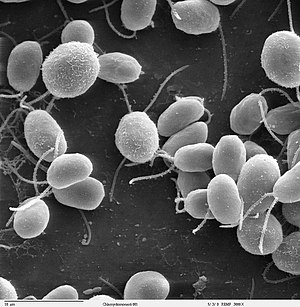
Chlamydomonas reinhardtii genome holds clues for renewable energy - University of Minnesota researchers contributed to a national effort to sequence the genome of an ancient, one-celled organism that will help advance research in a broad range of areas, from biofuels to restoring the environment to understanding a variety of human diseases
Chlamydomonas is a genus of unicellular green algae (Chlorophyta). These algae are found all over the world, in soil, fresh water, oceans, and even in snow on mountaintops. Algae in this genus have a cell wall, a chloroplast, an eye that perceives light, and two anterior flagella with which they can swim using a breast-stroke type motion. More than 500 different species of Chlamydomonas have been described, but most scientists work with only a few. - Source
Chlamydomonas reinhardtii is a unicellular eukaryotic alga possessing a single chloroplast that is widely used as a model system for the study of photosynthetic processes. This report analyzes the surprising structural and evolutionary features of the completely sequenced 203,395-bp plastid chromosome. - Source