Process Analysis of Alkaline Flocculation Harvesting for Chaetoceros muelleri and Scenedesmus quadricauda
Researchers from China performed an experiment to analyse the mechanism of alkaline flocculation harvesting process and the difference between the two strains of algae Chaetoceros muelleri (marine diatom) and Scenedesmus quadricauda (freshwater algae).
Alkaline flocculation of C. muelleri resulted in increase in particle size with increasing pH, 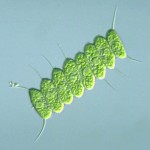 increase in absolute value of zeta potential and decrease in conductivity of the solution. Further the alkaline flocculation of C. muelleri resulted in production of magnesium hydroxide rather than calcium phosphate or calcium hydroxide.
Alkaline flocculation of S. quadricauda showed contrasting results, with no change in particle size, decline and increase of absolute value of zeta potential and conductivity respectively, thus showing that the cell wall of S. quadricauda with the high content of cellulose Iα and low crystallization degree was good for the next step of saccharification or oil extraction.